 Millions of people turn to Catholic Online for prayers, Daily Readings, saints, Catholic education and answers about their Faith. Most will never donate. But if Catholic Online has given you more than $5 worth of value this year, we're asking you to do something very simple: Give $5 today.
Your Catholic Voice Foundation also supports Catholic Online School, which has served 2.2 million student enrollments in 193 countries. We don't believe a family's ability to pay should determine whether a child can receive a Catholic education. If we've given you something of value, please give something back.
DONATE TODAY >>St. Thomas

Facts
Patron: of architects
Author and Publisher - Catholic Online
Printable Catholic Saints PDFs
Shop St. Thomas
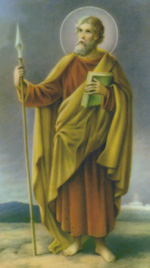
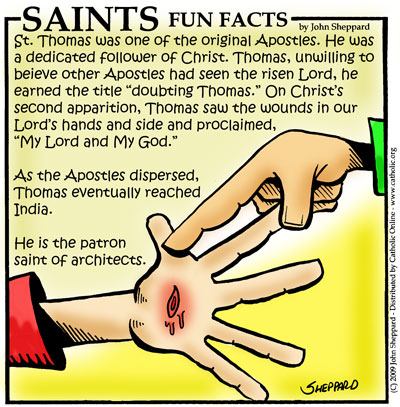
St. Thomas was born into a Jewish family and was chosen by Jesus Christ to be one of the Twelve Apostles. Although the dates of his birth and death are unknown, his feast is celebrated on July 3. He was among the first members of the Church founded by Christ and is honored today as the patron saint of architects.
Thomas was a devoted, courageous, and sometimes impetuous follower of Jesus. When Christ announced that He was returning to Judea to visit His friend Lazarus, despite the growing hostility of the religious authorities, Thomas urged the other Apostles, "Let us also go, that we may die with Him" (John 11:16), demonstrating both his loyalty and willingness to face danger alongside his Lord.
At the Last Supper, when Jesus told His disciples that He was going to prepare a place for them and that they knew the way, Thomas honestly admitted that they did not understand. His question prompted one of the most profound declarations in Scripture: "I am the Way, and the Truth, and the Life; no one comes to the Father except through Me" (John 14:6).
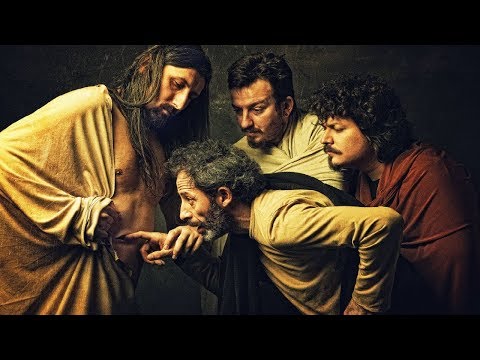
St. Thomas is perhaps best known for his response to Christ's Resurrection. When the other Apostles told him they had seen the risen Lord on the first Easter Sunday, Thomas struggled to believe, earning the familiar nickname "Doubting Thomas."
Eight days later, Jesus appeared again and lovingly invited Thomas to see His hands and to place his finger in the marks of the nails and his hand into His side. Scripture does not say whether Thomas actually touched Christ's wounds. Instead, upon seeing the risen Lord and hearing His invitation, Thomas immediately made one of the clearest professions of faith in the New Testament, proclaiming, "My Lord and my God!" (John 20:28). Jesus then declared, "Blessed are those who have not seen and yet have believed."
St. Thomas is also mentioned in the Gospel as being present during another appearance of the risen Christ at the Sea of Tiberias, when Jesus performed the miraculous catch of fish.
These passages contain all that Scripture tells us about St. Thomas. According to ancient Christian tradition, after Pentecost he traveled east to proclaim the Gospel among the Parthians, Medes, and Persians before eventually reaching India. The ancient Christian communities along the Malabar Coast continue to preserve this heritage and are known as the "Christians of St. Thomas."
Tradition also holds that St. Thomas was martyred in India while preaching the Gospel. One ancient tradition recounts that he died after being accidentally struck by an arrow intended for a peacock. Other traditions describe his martyrdom by spear. While the exact circumstances remain uncertain, the Church has long venerated him as a faithful witness who gave his life for Christ.
Following his death, some of his relics were taken to Edessa, while others remained in India. Relics associated with St. Thomas are venerated today in the Basilica of San Thome in Chennai (Mylapore), India. The relics transferred to Edessa were later moved in 1258 to the Cathedral of St. Thomas the Apostle in Ortona, Italy. Tradition also holds that his skull is preserved at the Monastery of St. John the Theologian on the Greek island of Patmos.
In Christian art, St. Thomas is often portrayed as a young man holding a scroll or as an Apostle gazing upon the wounds of the risen Christ, recalling his profession of faith. He is also frequently depicted with a builder's square or spear, symbols of his patronage of architects and his martyrdom.
St. Thomas is mentioned in several early Christian writings outside of Scripture. One such work, The Passing of Mary, relates the tradition that Thomas was the only Apostle to witness the Assumption of the Blessed Virgin Mary into Heaven. According to this account, he arrived after her burial and saw her being assumed body and soul into Heaven, receiving her girdle as a sign. When the other Apostles later found Mary's tomb empty except for the girdle, they came to believe his testimony. This tradition inspired many works of medieval and Renaissance Christian art, although it is not part of Sacred Scripture.
Prayer to St. Thomas the Apostle
Dear St. Thomas,
You were once slow to believe that Christ had truly risen from the dead. Yet when you encountered the risen Lord, you proclaimed with unwavering faith, "My Lord and my God!"
According to ancient Christian tradition, you also gave powerful assistance in the construction of a church where pagan priests opposed the work.
Please intercede for architects, builders, and carpenters, that through their work the Lord may be glorified and His people served.
Amen.
Come Grow With Us
Sign up and walk the Catholic journey with millions around the world.
Receive inspiring emails on saints, daily readings, and free faith-building resources—no cost, ever.
Catholic Online Is Free. But We Need Your Help.
Please Watch
- 7 Morning Prayers
- Mysteries of the Rosary
- Litany of the Bl. Virgin Mary
- Popular Saints
- Popular Prayers
- Female Saints
- Saint Feast Days by Month
- Stations of the Cross
- St. Francis of Assisi
- St. Michael the Archangel
- The Apostles' Creed
- Unfailing Prayer to St. Anthony
- Pray the Rosary







Copyright 2026 Catholic Online. All materials contained on this site, whether written, audible or visual are the exclusive property of Catholic Online and are protected under U.S. and International copyright laws, © Copyright 2026 Catholic Online. Any unauthorized use, without prior written consent of Catholic Online is strictly forbidden and prohibited.
Catholic Online is a Project of Your Catholic Voice Foundation, a Not-for-Profit Corporation. Your Catholic Voice Foundation has been granted a recognition of tax exemption under Section 501(c)(3) of the Internal Revenue Code. Federal Tax Identification Number: 81-0596847. Your gift is tax-deductible as allowed by law.