Amazing discovery in Canada reveals one man's controversial claim was TRUE
FREE Catholic Classes
Researchers at the Université of Montréal (UdeM) in Canada made an important discovery this year, changing a key element of North American history.

Evidence of stone tools used on a horse's jaw means humans arrived in North America thousands of years earlier than previously believed.
Highlights
California Catholic Daily (calcatholic.com/)
1/17/2017 (9 years ago)
Published in U.S.
Keywords: Humans, North America, Canada, cave, stone tools
LOS ANGELES, CA (Catholic Online) - New research suggests humans first traveled to North America 24,000 years ago, 10,000 years earlier than previously believed.
UdeM researchers analyzed animal bones, which have marks on them from stone tools used by man.
The oldest of these bones was a horse mandible, or bottom jaw bone. The evidence of tools used on the bones indicate man was present significantly earlier than originally believed and that they were advanced enough to kill, butcher and eat animals with the use of stone tools.
The bones, and other artifacts investigated, were discovered on the banks of the Bluefish River in northern Yukon near the Alaska border.
The site was excavated bettween 1977 and 1978 by archaeologist Jacques Cinq-Mars. Using radiocarbon dating on the bones, Cinq-Mars boldly claimed the settlement dated as far back as 30,000 BP (Before Present - a term used mainly in geology and other scientific disciplines).
The claim was highly controversial among others in the science community. The lack of other sites as old as that one, as well as the lack of animals whose bones were discovered at the site, made Cinq-Mars' "discovery" even more questionable.
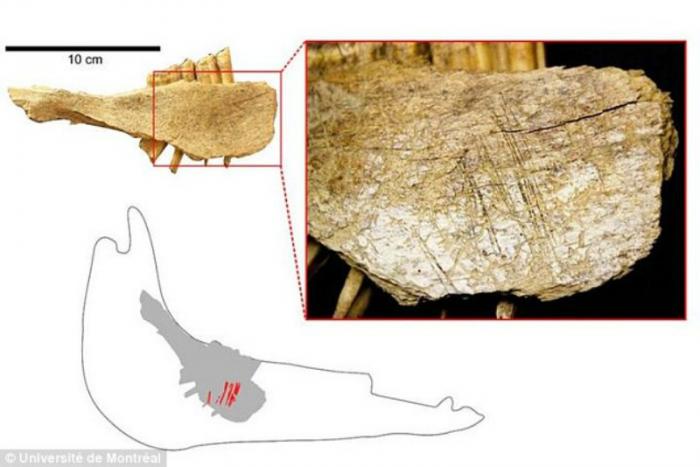
The oldest bone discovered was from a horse (Universite de montreal).
UdeM researcher Lauriane Bourgeon examined the bones and fragments from the site over a period of two years. Comprehensive analyses revealed undeniable evidence of human activity in 15 of the bones. Roughly 20 other gragments also showed human activity.
"Series of straight, V-shaped lines on the surface of the bones were made by stone tools used to skin animals," Ariane Burke, a professor at UdeM, explained. "These are indisputable cut-marks created by humans."
Bourgeon subjected the bones to radiocarbon dating, with the oldest fragment - a horse mandible - revealing a stone tool was used to remove the beast's tongue. It was radiocarbon-dated at 19,650 years, or between 23,000 and 24,000 BP.
"Our discovery confirms previous analyses and demonstrates that this is the earliest known site of human settlement in Canada," Burke stated. "It shows that Easter Beringia was inhabited during the last ice age....Our discovery confirms the 'Beringian standstill (or genetic isolation) hypothesis.'
"Genetic isolation would have coresponded to geographical isolation. During the Last Glacial Maximum, Beringia was isolated from the rest of North America by glaciers and steppes too inhospitable for human occupation to the West."
To read the full story, please read the study published in the journal PLoS One.
---
This article originally appeared in California Catholic Daily and is reprinted with permission.

Come Grow With Us
Sign up and walk the Catholic journey with millions around the world.
Receive inspiring emails on saints, daily readings, and free faith-building resources—no cost, ever.
Catholic Online Is Free. But We Need Your Help.
Please Watch

- 7 Morning Prayers
- Mysteries of the Rosary
- Litany of the Bl. Virgin Mary
- Popular Saints
- Popular Prayers
- Female Saints
- Saint Feast Days by Month
- Stations of the Cross
- St. Francis of Assisi
- St. Michael the Archangel
- The Apostles' Creed
- Unfailing Prayer to St. Anthony
- Pray the Rosary











Copyright 2026 Catholic Online. All materials contained on this site, whether written, audible or visual are the exclusive property of Catholic Online and are protected under U.S. and International copyright laws, © Copyright 2026 Catholic Online. Any unauthorized use, without prior written consent of Catholic Online is strictly forbidden and prohibited.
Catholic Online is a Project of Your Catholic Voice Foundation, a Not-for-Profit Corporation. Your Catholic Voice Foundation has been granted a recognition of tax exemption under Section 501(c)(3) of the Internal Revenue Code. Federal Tax Identification Number: 81-0596847. Your gift is tax-deductible as allowed by law.